September 3, 2025
Healthcare
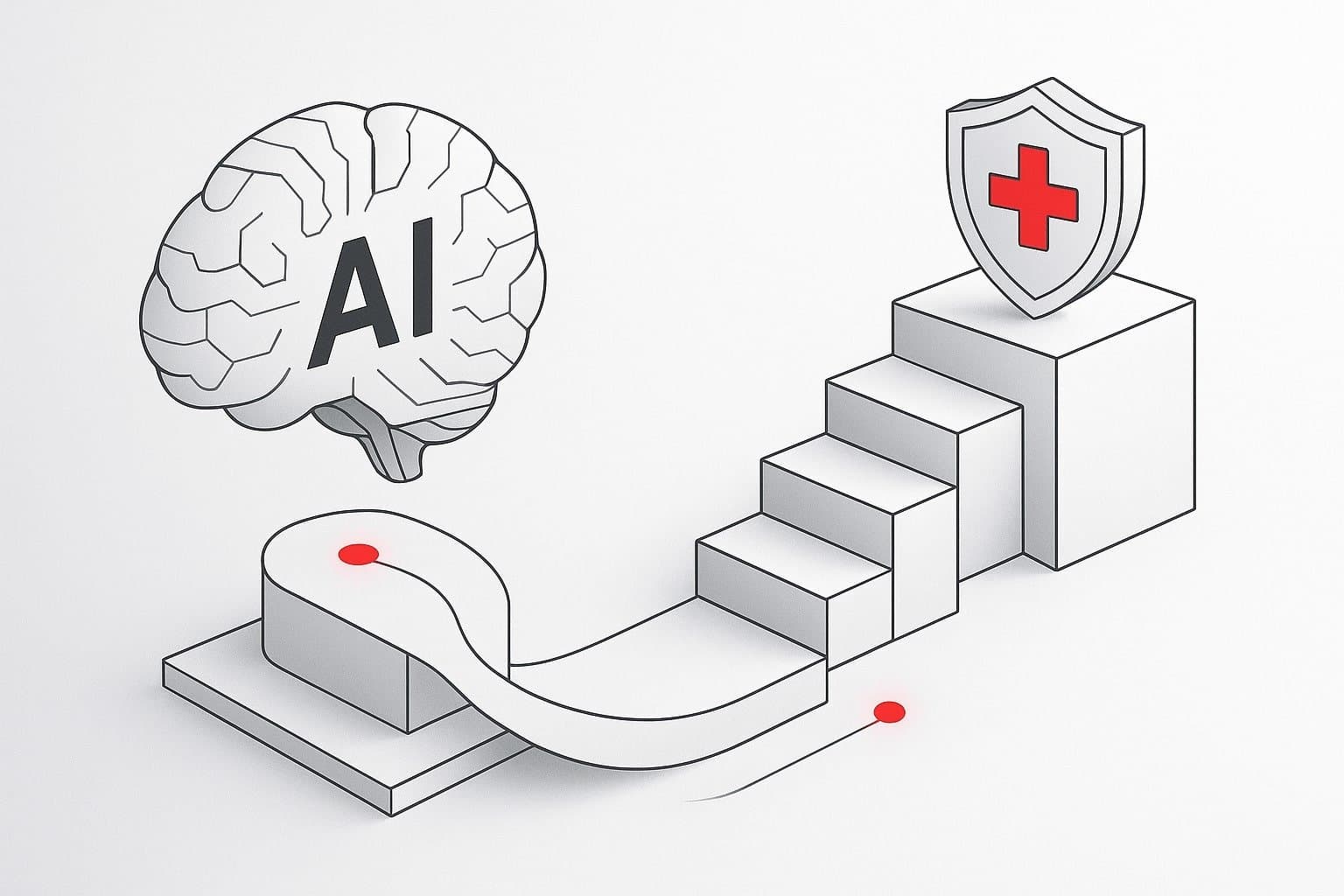
AI is no longer a buzzword in healthcare — it’s becoming the backbone of how hospitals, clinics, and health-tech startups operate. From predictive diagnostics to patient engagement automation, AI promises higher efficiency, better outcomes, and reduced costs.
But while interest is high, execution often falls short. Many healthcare AI initiatives stall after the pilot phase because organizations lack a structured implementation roadmap — one that bridges the gap between innovation and ROI.
This guide breaks down the AI implementation roadmap for healthcare, step by step — showing how to move from an initial idea to a proven, scalable AI solution.
Healthcare organizations face unique challenges when adopting AI:
A clear roadmap ensures that every stage — from identifying the right use case to scaling for ROI — is strategically aligned with patient safety, compliance, and business value.
Before jumping into model development, healthcare leaders must identify where AI can truly make an impact. The best AI use cases sit at the intersection of data availability, clinical value, and business outcomes.
Common AI Use Cases in Healthcare
Example:
A hospital struggling with long ER wait times identified an opportunity to use AI-powered triage systems. This reduced average waiting time by 30% and improved patient satisfaction scores.
Data is the foundation of any healthcare AI project. At this stage, teams should evaluate whether the necessary data sources, structure, and permissions are in place.
Key Considerations:
Example:
A radiology startup built an AI imaging model but failed to secure de-identified training data — delaying deployment for months due to privacy non-compliance. Lesson: Data governance must come before development.
AI implementation in healthcare isn’t just a tech project — it’s an interdisciplinary effort involving:
The collaboration between AI engineers and clinicians ensures that the model’s predictions are medically interpretable and clinically actionable.
With the problem defined and data ready, it’s time to build a Minimum Viable Model (MVM) — an AI prototype that solves one problem for a defined patient group or process.
Key Steps in the Pilot Phase:
Mini Case Study:
A multispecialty hospital piloted an AI-based sepsis detection system using EHR data. The model identified high-risk patients 4 hours earlier than human review — improving early intervention rates and cutting ICU stays by 20%.
An AI model is only as valuable as its adoption rate. Successful integration means embedding AI insights directly into existing systems and clinician workflows.
Integration Best Practices:
Example:
A telehealth provider integrated AI triage and sentiment analysis within its chat system. The tool classified urgency levels in real time, helping doctors prioritize patient queries — reducing average response time by 40%.
ROI in healthcare AI can be both quantitative (cost reduction, improved throughput) and qualitative (patient satisfaction, clinician efficiency).
Key ROI Metrics:
Example:
A private healthcare network implemented AI-driven claims automation. Within 6 months, processing costs dropped by 25% and approval turnaround time improved by 50%, translating to a clear ROI.
After a successful pilot and ROI validation, it’s time to scale. But scaling in healthcare demands robust governance.
Scaling Guidelines:
Tip: Scaling without explainability can hinder adoption — especially in clinical settings where AI explainability (XAI) builds trust and accountability.
Building a successful AI implementation roadmap for healthcare is not about deploying the flashiest algorithm — it’s about aligning technology with clinical and business goals.
From identifying opportunities to piloting solutions and scaling responsibly, each step brings you closer to measurable ROI and better patient outcomes.
If you’re ready to bring AI to your healthcare organization, MLab Innovations can help you design, validate, and deploy intelligent AI systems — safely, ethically, and effectively.
👉 Let’s turn your healthcare AI vision into impact.